
It was a state dinner at Kremlin Palace. The new Russian president, Vladimir Putin, three months into his job, was playing host to the US president Bill Clinton on the evening of June 4, 2000. It was a rather modest dinner of cold boiled boar, baked ham and cabbage, and goose with berry sauce. The evening ended in a personal theater with a jazz tribute to America’s legend Louis Armstrong for the two presidents.
Putin had met Clinton twice a year before, albeit as a prime minister. First one was in Oslo for a tribute to the late Israeli prime minister Yitzhak Rabin and later, at the annual economic summit of Pacific Rim countries. Putin was charmed by Clinton who went across other head of states and walked along with him in the corridor. “I appreciated the sign of special regard,” Putin was to say later.
Now as president, face-to-face, Putin told Clinton he saw Russia’s future as a European nation. He wanted Russia to be admitted in NATO. This wasn’t the first instance: In 1954 too, the Soviet Union had expressed its readiness to join NATO. “On both occasions we were essentially refused outright,” Putin was to say this October in his Valdai Club speech.
Putin though continued to be an admirer of West. He was from St. Petersburg, the most Western of Russian cities, and gushed on thinkers such as Thomas Hobbes and John Locke. In 2005, Putin was effusive in his praise of Emmanuel Kant in Russia’s Kaliningrad where the leading light of Enlightenment was born in 1724. Putin, in his own words, in 2002: “…Russia is without any doubt a European country, because it is a country of European culture.” He was every inch the liberal the West didn’t mind taking over Russia in post-Yeltsin period.
Broken Spell And Two Thinkers
The spell took a few years to wean off. In 2004, Beslan terrorist attack occurred. Russia was forced to invade Georgia in 2008. Putin’s third presidential term began in 2012. By now he was all “Holy Russia” in his utterances. West was on rosary of homosexuality while Putin was stressing on “Christian values.”
In the autumn of 2013, Euromaidan protests were planted in Ukraine. Putin saw it for what it was: West’s machination to mould Ukraine as a festering wound for Mother Russia. Couple of months before the regime changed in Kiev, Putin declared: “Euro Atlantic…Anglo Saxon countries…are revising their moral values and ethical norms.” He called for a “defense of traditional values” and acknowledged his was a “conservative position.”
It was now return to history and Russian philosophers of the 19th century who had been ignored in their time during the Tsardom and later in Communist Russia — Nikolay Danilevsky (1822-1885) and Konstantin Leontyev (1831-1891). The two were contemporary of the Crimean War (1853-1856) and were aghast at Catholic and Protestant powers of Europe siding with the Muslim Ottomans against Christian Russia! Putin’s speeches from now on were often laced with references to these two thinkers.
Danielvisky in his “Russia and Europe” stressed no progress would occur if all nations walked the same linear road that the West wanted the rest of world to tread. He believed progress would come by “walking in all directions.” Leontyev, in his “Byzantinism and Slavdom” advocated a multi-civilizational world order where each followed its own civilisational path without conforming to Western norms.
Leontyev was for a distinct Russian identity, a foreign policy which ditches Western influence and opts for its own conservative, traditional heritage. Leontyev was for a cultural alliance between Russia and East.
Russia and Its Asian Heritage
This in essence is Eurasianism. That Russia is Slavic of course but also a construct of Ugro Finns and Volga Turks —a civilization whose heart beats from Yellow Sea to Black Sea. It is Turnaian East; that Russians and Asians are rooted in the same invisible racial strand; that Russia has nothing in common with West; that Russia knew nothing of feudalism, Latin culture on Renaissance; that even if most Russians live in West of Ural Mountains in Europe, it’s in east of Ural Mountains, in Asia, where most of Russia is geographically located.
Putin has said for last 250 years West has worked on the unilinear theory of the world – that everyone follows its financial, cultural, technological model, a kind of standardization, which it terms globalization. But it’s neocolonial in nature. West promotes democracy where people of all ethnic hues must have equal rights — yet nations are not allowed this “democratic” freedom and must submit to its diktat!
Today, Russia’s official foreign policy concept, states that the international order should be founded on a “diversity of cultures, civilizations, and models of social organisation.”
Modi and Macaulay
India has its own historical wounds by the West. Twice in last fortnight, India’s prime minister Narendra Modi has exhorted citizens to shed the mentality of slavery. He termed it the Macaulay effect, a reference to the British member of the governor general’s council in the 19th century, who wanted Indians to look one only in appearance but not in mind or conduct. Macaulay buried India’s indigenous education system and imposed the colonial one. He took Indians away from their roots.
Modi wished Indians choose their own heritage, indigenous knowledge and methods without compromising on learning from the world. By 2035, when it would be 200 years to Macaulay’s project of 1835, Modi implored Indians to get rid of this mental slavery and rediscover their original self for India’s salvation.
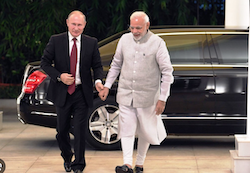
So when Putin touches down in India on Thursday, and his bonhomie with Modi is splashed across newspapers, we would be witnessing two representatives of distinct civilizations which are in the process to shed the baggage they carried of West.
Fittingly, they are also torch-bearers of a coming multipolar world; unabashed in tracing their Hindu and Orthodox Christian roots. They would be choosing their own and not unilinear path of someone else. This new order won’t come in a hurry, the world would be more complex but the tools would be their own and not borrowed.
What’ On Table
Sure enough we would hear of diversified trade in new sectors and not just in defense, technology or in oil deals. It’s time it happened too for despite the unreal level of trust between the two nations, so geographically apart, the business volume bears little reflection of this bond.
For some time there’s been a whiff of Russia seeking out Indian labour for its industrial regions. It needs a million of foreign workers which would swell to over three million needed by 2030. Skilled Indian professionals would be great assets in Russia’s machinery and electronics sector. Thus far, much of India’s labour is engaged in textiles and construction sectors. Only last fortnight, India has opened two new consulate generals in Kazan and Yekaterinburg, the latter a center of Sverdlovsk Oblast which is heart of Russia’s heavy industry and defense manufacturing.
The demography of the two nations is telling: Russia’s population is 146 million compared to 1.46 billion of India. Its median age is nearly 42 years while India’s is 29! It’s great potential waiting to be tapped.
India, likewise, has set itself a target of increasing its nuclear power generation capacity from 10Gw to 100Gw. Russia is of incalculable help in this task. It presently is constructing four units of India’s largest nuclear power plant in Kudankulam, Tamil Nadu. Two units of 1,000MW capacity were connected to India’s national power grid in 2013 and 2016.
We might also hear more on India’s involvement in Russia’s Arctic initiatives. There is considerable energy and scientific tandem in maturing the Northern Sea Route (NSR) which could be connected with India’s Chabahar port in Iran, and thereon access to Indian Ocean. India’s Talwar-class frigates are designed for Arctic. Joint ventures are afoot in Arctic oil and gas extraction. All this prompted India to launch its own Arctic Policy in 2022.
It’s not just about India and Russia. It’s about offering options to the rest of the world who don’t wish to be chained to either of the two superpowers. India and Russia have much to gain in creating this vector. Both are seeking their traditional, civilisational roots to power their future.