

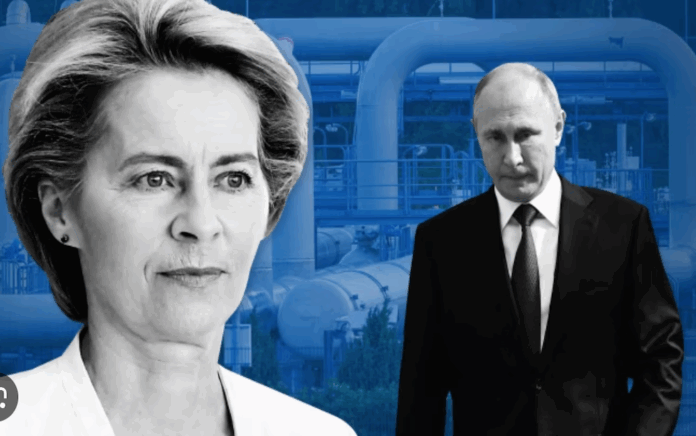
Next two days (December 18, 19) could well decide if European Union has put its existence in grave peril.
In the European Council meeting on these two days, the top agenda is providing loan to Ukraine through the collateral of frozen Russian assets amounting to $220 billion with Euroclear, a clearing house, based in Belgium.
Overall, $300 billion of Russia’s funds are frozen under sanctions.
Geopolitical experts view it as EU’s move to scuttle the US-initiated peace plan on Ukraine War in which the issue of frozen Russian assets and its future usage is a vital point.
The EU’s belligerent honchos are determined to take this course as evident by their measure of last week when they invoked the emergency powers under Article 122 (1) of EU law to bypass the eventuality of any veto scuttling their plan. Now a simple majority would win them the day — but it’s bound to come back and hurt them grievously in very near future.
The EU also decided to indefinitely freeze the Russian assets under sanctions instead of deciding on it every six months as has been the pattern thus far.
The frozen Russian assets are largely with Euroclear which holds wealth of 103 Central Banks to the tune of $47 trillion. It is the centrepiece of this drama. Euroclear has gone public to say that seizure of Russian assets, or using it as collateral or raising interest on it to loan to Ukraine, is illegal. However, being based in Belgium, which operates under the EU, it is powerless to stop the move.
Twisting Law to Suit End
The EU law expert Christina Vanberghen views the enforcement of emergency measures under Article 122 (1) as brazenly illegal and fears the repercussion could hit the very foundation of the European Union.
Vanberghen says that Article 122 is an economy-policy tool not an instrument for political, foreign policy or sanctions. The Article 122 (1) clearly states it could only be triggered under “severe difficulties in the supply of certain products, notably energy” or threats to the balance of payments. In no way a geopolitical move could be equated for “economic emergency.”
Besides, the EU doesn’t have an authority to use the assets of a third-state to benefit another third state not in its fold. Under international law, Central Bank assets enjoy near-absolute immunity. It could only be bypassed if there is a peace treaty between two parties to this effect.
There is another caveat to this EU madness: Article 122 (1) can’t be used to grant financial assistance. This power rests with Article 122 (2) which again is used in case of severe financial problems and not under exceptional security contexts. All Article 122 (1) does is to permit emergency measures which overrides any veto in the house. Further, this March, the Council proposed to create a SAFE (Security Action For Europe) instrument to expand Europe’s arms industry to the tune of 150 billion Euros, again under Article 122.
Neither of the two moves, the one of using Russian assets as a collateral assistance for Ukraine or to raise 150 billion Euro for arming up Europe, could be fitted on financial grounds. These are out-and-out geopolitical moves. Article 122 is an economic-policy tool—not a foreign-policy or sanctions instrument. It won’t stand in any court of law.
The move is outrageous on another count: The EU invoked the emergency clause of Article 122 (1) which allowed it to bypass the EU Parliament.
There of course is a provision in EU law where a third country’s sovereign reserves could be frozen. But it comes under Article 125 which requires a unanimous vote from all nation-members of the EU.
Feud In The Family
Hungary’s president Viktor Orban calls it a “rape of EU law”; Belgian prime minister Bart de Wever dubs it “stealing” the Russian money. International financial institutions including the European Central Bank (ECB) and IMF also have cautioned it would end up undermining the confidence in Euro. Christine Lagarde, president of ECB, has warned it could inflict lasting damage on EU’s financial system.
Orban says the move could trigger the fall of many European governments in a domino effect — they have spent nearly 100 billion Euro of its taxpayers with the promise that all of it would be repaid by Ukraine. But now Ukraine’s fall is imminent and citizenry in western Europe would have footed the bill from their pockets. There would be a revolt next morning.
Belgium fears a legal fallout and the resulting reparations would be beyond them. They have demanded guarantees from other EU members to share the burden in case reparations are to be paid. Czech leader Andrej Babis said his country simply can’t afford if Prague was to end up paying $4.3 billion in its share. “We don’t have money for other countries…we are not going to give money either because the coffers are empty,” Babis stated.
Poland’s prime ministr Donald Tusk is not convinced too. He terms it economically reckless and catastrophic; and that it would drive the investment away from Europe and gravely hurt Euro’s status as a reserve currency.
But EU bosses are doubling down. German Europe minister Gunther Krichbaum has said countries which don’t cooperate on reparations loans to Ukraine, backed by frozen Russian assets, would suffer severe economic consequences.
Before the EU meeting on December 18-19 gets going, a Moscow court has agreed to hear the $230 billion lawsuit filed by the Central Bank of Russia (CBR) against Belgium’s Euroclear over immobilised sovereign assets.
Euroclear rightly suspects that the Moscow court would rule in favour of Russia Central Bank following which assets of its clients in Russia, some $16 trillion, could then be frozen or confiscated in retaliation. It suspects that it could lead to a run on Euroclear with investors withdrawing their assets. It would not only go bankrupt but if similar legal strictures are passed elsewhere, as it could in Hungary or Slovakia, Euroclear could be asked to pay heavy damages which it would be in no position to repay.
Even if the lawsuits don’t materialise but if Sanctions on Russia are lifted in future, Euroclear would be busted for it would be in no position to return Russian assets in entirety to its lawful owners.
Article 122 was invoked for its emergency clause which armed the Council with the power to legislate on its own, bypassing the European Parliament. If a case is filed in Luxembourg Court, most likely it would be ruled in the favour of European Parliament. Both the European Union and Euroclear could have joint liability of hundreds of billions of dollars.
If the General Court or the European Court of Justice strike down the 150 billion Euro defense fund for exceeding the scope of Article 122, there is no way the EU’s move on frozen Russian assets would survive the judicial review.
Trump Is Disgusted
In Washington, the US president Donald Trump is viewing the machinations of EU with unconcealed disgust. Polish prime minister Tusk says “the US has asked EU to leave the frozen Russian assets alone because it’s hard to sit down at the negotiating table with Putin and say, `Let’s make a compromise, but we’re taking your money.”
It is learnt that the Trump is looking to remove Austria, Hungary, Italy and Poland from the EU which would be a blow in the gut to the bloc. It would amount to fracturing the shabby EU along its key faultiness.
As per reports, Trump has already floated an idea to replace G7 with CF (Core Five) which includes China, the United States, India, Russia and Japan. It would be a serious humiliation be it to Germany, France or Great Britain, the real movers in Europe for Ukraine.
The EU clearly is tying itself into knots. It’s citizenry could hardly be convinced that all this is to prolong war for a third country which they have nothing to do with. And to spite the “big daddy” United States for saving a few of EU elites. If Euro loses out, who benefits? It’s Dollar only!
Besides, recent raids have shown that Ukraine is mired in deep corruption and billions of dollars of aid has been siphoned off. Many more billions to them could only mean that it’s being cycled back to EU elites at the cost of continent’s well-being. It’s neither morally nor strategically prudent.